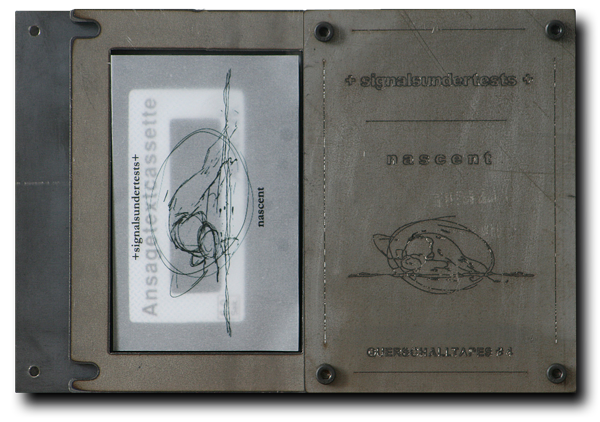
“Beautiful Beginning” was released in August 2009 to help raise money for the Motor Neurones Disease Association Northern Ireland. Thank you to all those who have made a donation. If you have not made a donation yet, you can do so by purchasing the release from Bandcamp or iTunes. Please continue to donate generously.
“Beautiful Beginning” is now available on Spotify and iTunes. More information on the MNDANI can be found at www.mndani.com
Signals Under Tests - “Live at Verbal Arts” - Beat Magazine Review
“Even though the Irish duo, consisting of Ricky Graham & John King, is actually still working behind the scenes on their first studio album with great attention to detail, this live recording sounds already stunningly mature and in no way like a test. Highly minimal sound grounds, with a high affinity for backward loops, are cut by glamorous jazz-specific guitars and extend up to eleven minutes as in dream time. The enigmatic cover by Walter Logeman congenially complements the music.”
All music by Ricky Graham. Music Box (DJ Elemental Remix) By Colin Cathcart. Vocals by Robbie Reid and Louise Sands on “Beautiful Beginning.” Trumpet by Andrew Kitchen on “Beautiful Beginning.” Mastered by Bernard Flanagan. Original Artwork by Ryan Locke. This release is dedicated to the memory of Patrick McGreevy.
The proceeds of this release will be donated to the Motor Neurones Disease Association of Northern Ireland. Due to the few cases of MND every year in the U.K, the research is underfunded and the care services are understaffed. To date, there is no known cure. By giving generously, you are helping researchers and carers for MND throughout the UK. There is more information on the organisation at www.mndani.com.You can make your own donations here! Thanks to everyone who have been involved in these releases over the last few years. Please share this blog entry via email, facebook, twitter, myspace, etc. and help spread awareness of MND.
“According to some scientists, aesthetic perception is a combination of memory and neural interference - the mind being simultaneously massaged with images from the past and confronted with confounding new sensations. If this theory were indeed true, Signals under Tests have all the potential of turning into one of the top newcomers in the Sound Art category this year. Their debut album “Live at Verbal Arts” (released as a free download on the Hippocamp Netlabel) presents a style that is at the same time recognisable and refreshing. Performing with utmost delicacy, their freely drifting, warmly grooving soundscapes are both meditative and stimulating, precisely organised and propelled by a surreal kind of dream logic. Fans of the drone genre will love how their minimal Guitar motives coalesce into shimmering impulse-textures, with the band basing their technique on the observation that “the relatively short sustain of plucked notes on an Electric Guitar can present limited scope in multiple speaker array performances”. Friends of Ambient works and Soundscapes should fall head over heels for the sonorous qualities and organic breath of these up to twelve minute long compositions. Jazz aficionados, meanwhile, are bound to applaud as the band infuse their dizzying mood streams with tender licks of bluesy timbres. As if that weren’t enough, this colourful combination is bound together by a conceptual foundation based - at least partially - on Arnold Schoenberg’s “Klangfarbenmelodie” (”Melody of sound-colours”). Even though Signals under Tests were only formed late last year, they already sound as confident and mature as any established act. Which is probably because two experienced players from the Northern Irish scene are hiding behind this moniker: Ricky Graham has built a career as a solo artist and a curator, while John King has excelled as a DJ. The juxtaposition of their distinct ideas and musical visions has yielded the purest of aesthetic propositions: Prepare yourself to be thoroughly moved and pleasantly confounded.”
The perception of dynamic trajectories in live music performance has become of immediate importance since the conception of the Signals Under Tests project [1]. The relatively short sustain of plucked notes on an electric guitar can present limited scope in multiple speaker array performances [2]. One method of remediation has been to employ “live looping” techniques [3] and other experiments with DSP. However, at this early stage of the project, perhaps DSP is not an appropriate method to encourage sustain beyond the naturalresonance of the electric guitar. A sustain pickup seems to be the most heuristic method for the time being. The Fernandes Sustainer [4] and the Sustainiac Stealth Plus [5] are the two pickups that seem the most available and suitable.
Alan Hoover at Maniac Music explains the similarities between the two models;
“The Sustainiac Stealth Plus and the Fernandes sustainer are both Electromagnetic sustainers for electric guitar. Both take the bridge pickup signal, amplify and process it, and then apply this amplified/processed bridge pickup signal to the electromagnetic driver transducer (”driver” for short). The driver then transmits a pulsating magnetic field in response to the amplified bridge pickup signal. This pulsating magnetic field causes the string vibrations of the guitar to be sustained as long as you hold the note. Simple hand-muting stops the sustain. Both systems have different “harmonic modes”. In other words, we do other electronic processing which forces the strings to vibrate differently, in such a way as to produce harmonics, kind of like a very loud amplifier does (only much more forcefully and musically, and also predictably). It is a very cool sound for many types of music. This is where the similarity stops.”
Alan Hoover at Maniac Music explains the differences between the two models;
“Our patented circuit designs allow you to use common push-pull controls which simply replace your existing guitar controls, in most cases without having to drill new holes in your guitar body. Installation of the Sustainiac circuit into most guitars can be done without having to route a new (large) cavity into the guitar. With the Fernandes, you will likely have to do a substantial route into the back of your guitar in order to fit it in. These are the main differences.”
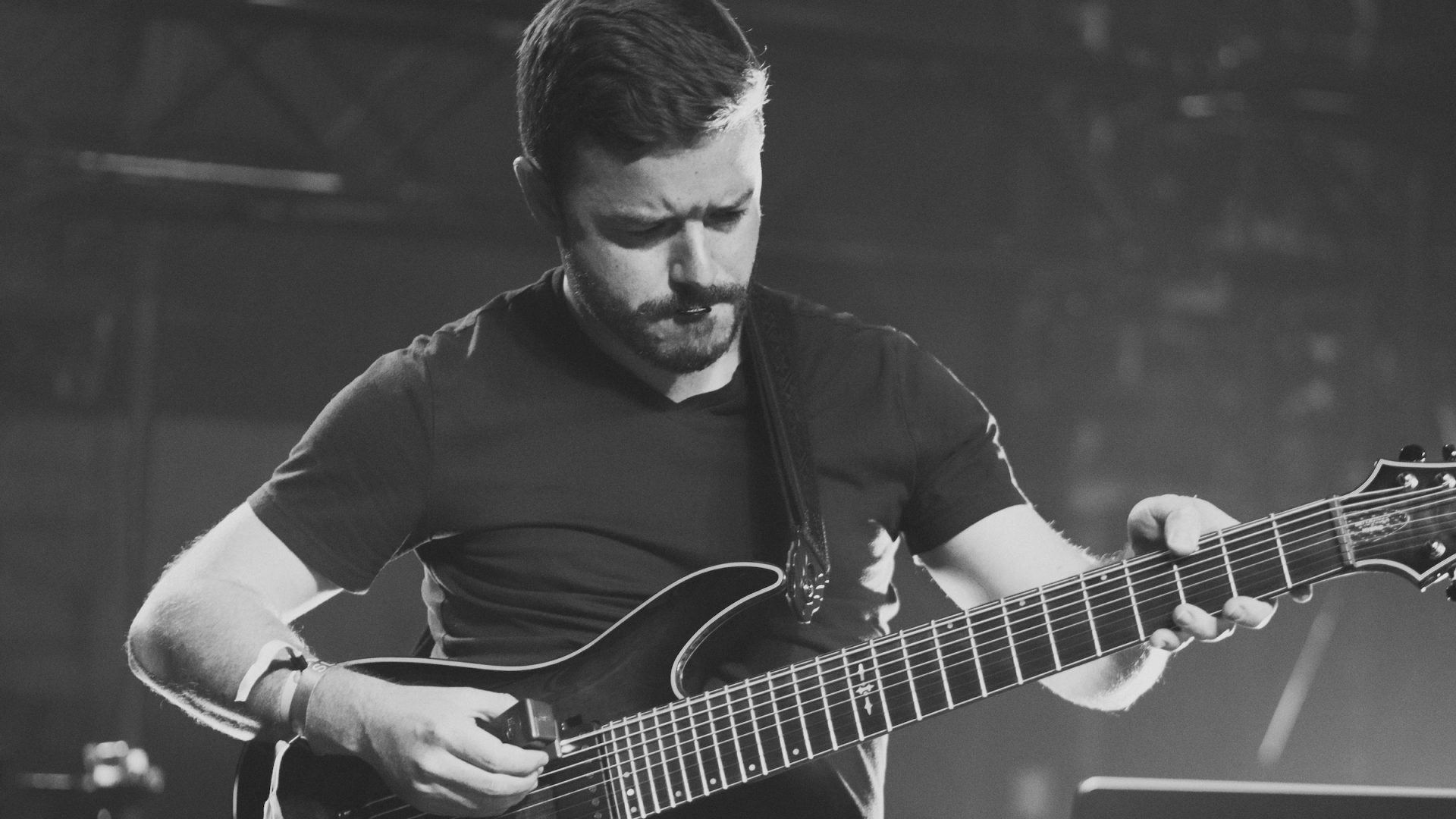
While the Sustainiac seems to be tidier in terms of specification, the Fernandes sustainer is a little more affordable and it just so happens that I have a luthier who I trust to cut a new cavity in my guitar. Also, I have been trying to shift a little of the weight of the body since it is made of ash and it is quite heavy. I have included a short overview of the installation process below.
A new cavity had to be cut to fit the Fernandes sustainer circuit board.
The pickup system needed to be wired to the existing pots, the three way pickup selector, and the existing jack socket. The cavity was grounded with aluminum foil in an attempt to reduce any noise that was present.
Two toggle switches are present on the board to switch between the two harmonic sustainer modes and to switch the pickup on and off. These are located under the bridge of the guitar.
The pickup works relatively well and helps to further develop performance techniques in multiple speaker array based live performances. However, I am interested to see if Maniac Music will develop the polyphonic sustainer pickup they have mentioned here. [6]
A short audio sample is available below;
Audio clip: Adobe Flash Player (version 9 or above) is required to play this audio clip. Download the latest version here. You also need to have JavaScript enabled in your browser.
My track, “Refraction”, is being considered for the new Rock Band Network. I wrote “Refraction” back in 2005, and performed an arrangement of it with Irish metal band, Shiro from 2007 to 2008. You can hear a sample of the track below.
Audio clip: Adobe Flash Player (version 9 or above) is required to play this audio clip. Download the latest version here. You also need to have JavaScript enabled in your browser.
And here is a video of me playing a few extracts about 3 years ago. Fun times.
Friend and fellow Musician, Jay Dickson, performed “Refraction” at a recent drum clinic with drum kit legend, Thomas Lang. Check out the clinic video on Jay’s website.
The diagram above breaks down the pin assignments of the 13 pin DIN connection. The break out box would allow me to access individual audio for each string on my electric guitar. In researching the construction of this box, I found two excellent sources of information.
The first was Jeff Berg’s website, Unfretted.com, and the second was Dublin based Electroacoustic Composer, Enda Bates. Pins 1 - 6 correspond typically to strings 1 - 6, the 7th pin corresponds to the sum of all 6 strings, and pin 12 is where power is sent via a 9v battery. In my case, the 7th pin will correspond to the 7th string of my electric guitar. Jeff Berg’s excellent guide to building your own break out box is available here. It is very important that you read Jeff Berg’s instruction and that you ground the box properly. Do not construct this in the bath etc.
I required a female 13 pin DIN connection, 7 female jacks, and some heat shrink tubing so that I could make the connections more robust. Thanks to Taku for the recommendation of heat shrinking.
I soldered pins 1 - 7 to the tip contact of each female jack socket. It is important that you ground the sleeve of each jack along with the shield of the 13 pin DIN connection.
Once the connections began to take shape, I then built it into a cable. I used a little bit of PCB for all my grounding.
And then into a box. I managed to fit the cable into a box the size of a D.I. box. One thing I would suggest is that you use a box with a little more weight if you plan to use a loom cable so that the box does not become damaged due to the weight of the cable.
The aim of this project is to make my electric guitar fully polyphonic. I have chosen to install the Ghost Modular Pickup System by Graph Tech Guitar Labs.
The piezo pickups come preloaded in a Floyd Rose saddle for an easy installation.
The existing saddles are replaced by the piezo saddles. The piezo connection is then threaded through the cavity of the guitar to the Hexpander board. The DIN 13 jack socket is connected to the Graph Tech “Hexpander Board” that conditions the piezo signals. “The Hexpander Modular Pre-amp features a proprietary harmonic damping system that results in tracking that is unequaled by any other system on the market today, with responsive and accurate triggering.” [1]
The term “Hexaphonic” is misleading in that it assumes that users utilise the pickup system on a six string guitar. Inventor and Musician, Matthias Grob explains this on his website.
“Some say “Hexaphonic”, which is only correct as long as the instrument has 6 strings, so we prefer “Polyphonic” here: Polyphony has its specific meaning in the music history, but the word itself simply means that there are several “sounds” and we understand several “voices” or notes. Of course this is the case for any ordinary guitar, but conventional technology treats all notes as a single sound source - which is often not in the sense of the musician!” [2]
A seventh pin is provided to allow a user to connect the sum of all the piezo pickups. Given that I am using a seven string guitar, I simply connected a seventh piezo to the seventh pin so that I have independent audio for all seven strings. I intend to mix the magnetic monaural pickups with the piezo pickups.
edit; 12/11/2009
The 7th pin (marked with a circle) on the second row of the Hexpander board ceased to function once the Fernandez sustain pickup was installed. Audio for the 7th string could be obtained once again by reconnecting the piezo pickup for the 7th string to the magnetic channel (marked with an M) on the first row of the Hexpander board. My thanks to Morgan Ahoff at Graphtech Guitar Labs for helping to resolve this issue.
Here are two early audio examples of the polyphonic guitar system. This is material being developed under the alias of Signals Under Tests, a project with DJ and programmer, John King.
Polyphonic Guitar Sample 1
Audio clip: Adobe Flash Player (version 9 or above) is required to play this audio clip. Download the latest version here. You also need to have JavaScript enabled in your browser.
Polyphonic Guitar Sample 2
Audio clip: Adobe Flash Player (version 9 or above) is required to play this audio clip. Download the latest version here. You also need to have JavaScript enabled in your browser.
Thanks to Michael Barkley for his Luthier skills, and to Morgan Ahoff at Graph Tech Guitar Labs for all his direction on this project. The next step is to build a break out box that provides the pickup system with power.
9 Jul 2007 20:00
Kaetsu University Seminar, Tokyo
Big thanks to Simon “Sensei” Clay at Kaetsu University for the invitation to perform at such a receptive University.
9 Jul 2007 21:00
Rock Factory, Tokyo (Roppongi)
Performance time - Approx 15 minutes
Music - “1314″ & Improv
Audience - 20+, very receptive. Local music moguls were thoroughly impressed. Jammed with Tokyo based Hip-hop artist, Dave Whitaker.
10 Jul 2007 19:00
The Pink Cow, Tokyo (Shibuya) - Workshop
Performance time - Approx 50 minutes
Music - “1314,” Improv, & “Decadence”
Audience - Very receptive. I networked with some very enthusiastic Musicians from Tokyo and Fuji. Traded music and contact information etc.
10 Jul 2007 20:45
Cosmo’s, Tokyo (Shibuya)
Performance time - Approx 60 minutes
Music - “1314,” Improv, “Absolution,” “Music Box,” “The Sky Above,” & “Decadence”
Audience - Mainly those who followed on from the previous workshop. An intimate atmosphere and a very receptive crowd.
10 Jul 2007 22:00 *
Ruby Room, Tokyo (Shibuya)
Performance time - Approx 15 minutes
Music - “1314,” & Improv
Audience - 50+, very receptive crowd and a very intimate setting. Perhaps the best performance of the tour.
11 Jul 2007 21:00
Ruby Room, Tokyo (Shibuya)
Performance time - Approx 20 minutes
Music - “Absolution,” “1314,” & Improv
Audience - 30+, mainly Japanese & American. Networked with A&R at KR-International, CD Lunch, and other Tokyo based music representatives with ties at Sony BMG, Tokyo.
I fell asleep around 5am in a Punk bar, during which time Ross and Duncan covered me in ice cubes. Cheers lads. I believe my name is also written on the wall of the bar along with some other visiting Musicians. Ross had also written his name underneath in what would appear to be morse code. Thanks to the bar staff for playing old school Metallica all night. A nostalgic night was had.
12th Jul 2007 21:00
Cosmo’s, Tokyo (Shibuya)
Performance time - Approx 30 minutes
Music - “Absolution”, “1314,” & Improv feat. Dave Whitaker.
Audience - 20+, intimate crowd, very receptive, & thoroughly enjoyable.
I later got up to jam with three Jazz musicians, two of which were from Tokyo (Guitar & bass) and the other from London (Saxophone.) We jammed for about an hour or so. This gig was a great way to end a successful tour.
Thanks to Dave and Meg at KR-International for organising a great induction tour of Japan. I’m looking forward to working with you both and the label in 2008. Thanks to Ross (as always) for being himself and his amazing host family, Koido, for looking after us. Thanks to everyone who I met at Wakeijuku. Thanks to all those who I met up with while I was in Japan, especially Duncan, Dave Whitaker, Hide, Megumi, Claire, Nosomi (Mimi), Anna, Maria, Simon, and Toma and the lads.